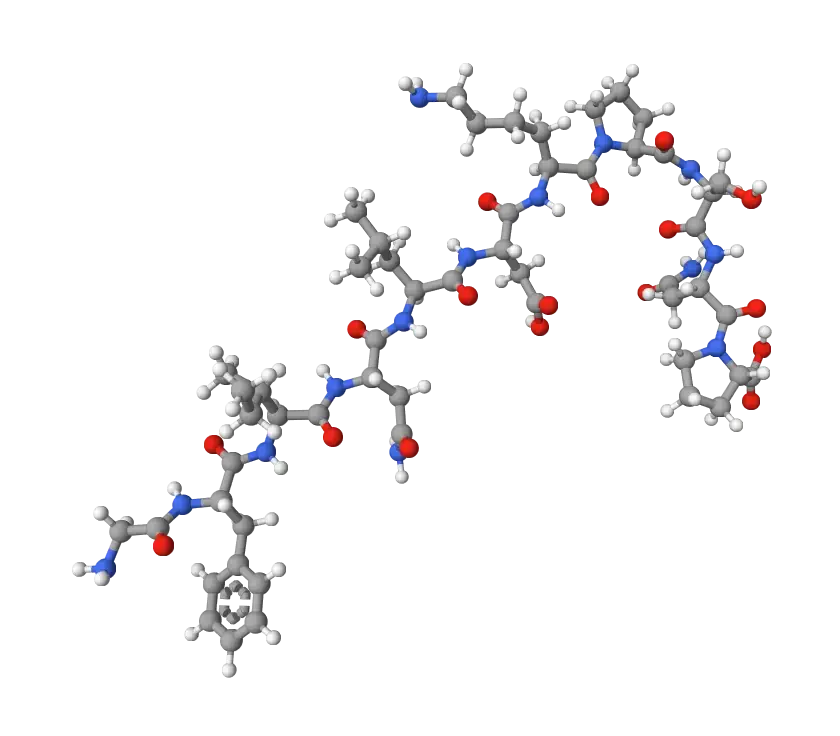
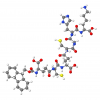
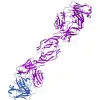
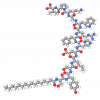
sh-Oligopeptide-85 SP is a synthetic human recombinant peptide that has the sequence Gly-Phe-Ile-Asn-Leu-Asp-Lys-Pro-Ser-Asn-Pro corresponding to the part of the TruB domain of the human Dyskerin (89-100) protein. In the scientific literature, peptide GSE4 is a smaller fragment of GSE24.2 and is also marketed under the trade name Tectum-11®.
sh-Oligopeptide-85 SP is developed and studied by a research group of the Higher Scientific Research Council (CSIC) that studies diseases characterized by alterations in the natural DNA repair machinery. It increases telomerase activity and reduces DNA damage, oxidative stress, and cell senescence.
When applied topically, sh-Oligopeptide-85 SP, packed in biodegradable polymeric PLGA nanoparticles, promotes the regeneration and renewal of damaged skin and protects epidermal cells. It stabilizes DNA repair and protects against oxidative stress by activating the production of antioxidant enzymes, such as catalase (Cat) and superoxide dismutase (SOD), which eliminate free radicals, including ROS and NOS, from cells.
An in silico study indicated the potential effectiveness of sh-Oligopeptide-85 SP for the treatment of chronic skin inflammatory conditions and diseases, including radiodermitis, pruritic skin lesions, xerosis, and ichthyosis. The anti-inflammatory action of the mouthwash containing this peptide will be evaluated in a clinical trial at Complutense University of Madrid for the symptomatic treatment of oral lichen planus.
GSE4, a Small Dyskerin- and GSE24.2-Related Peptide, Induces Telomerase Activity, Cell Proliferation and Reduces DNA Damage, Oxidative Stress and Cell Senescence in Dyskerin Mutant Cells
Author(s):
Iarriccio L, Manguán-García C, Pintado-Berninches L, Mancheño JM, Molina A, Perona R, Sastre L
PMID:
26571381
DOI:
10.1371/journal.pone.0142980
GSE4 peptide suppresses oxidative and telomere deficiencies in ataxia telangiectasia patient cells
Evidence of telomere attrition and a potential role for DNA damage in systemic sclerosis
Author(s):
Usategui A, Municio C, Arias-Salgado EG, Martín M, Fernández-Varas B, Del Rey MJ, Carreira P, González A, Criado G, Perona R, Pablos JL
PMID:
35086525
DOI:
10.1186/s12979-022-00263-2
Incorporating GSE4 peptide in PEG/hyaluronic acid hydrogels to promote the alveolar epithelial differentiation of mesenchymal stem cells
Author(s):
Wang Xiaoqiong, Cui Leisha, Hong Jing, Wang Zhaojun, Li Jiawei, Liu Zhongqing, Zhu Zhanchi, Hao Ying, Cheng Guosheng, Jiang Junhong
DOI:
10.1016/j.polymer.2023.125861
Novel Immune-Modulating Peptide to Counteract DNA Damage and Boost Tissue Repair: Advanced Machine Learning Confirmation Over Transcriptomes From 3,250 Patients
Author(s):
Ribagorda María, Cazurro P Gutiérrez-, Pérez-Cano Jordi, E. Nuñez Jessica, MF Carbache, Rodríguez Joaquin Carballido, Pablo Castan
DOI:
10.54615/2231-7805.143018
Development and validation of a rapid HPLC method for the quantification of GSE4 peptide in biodegradable PEI-PLGA nanoparticles
Acetyl Tripeptide-30 Citrulline is a synthetic peptide that prevents the degradation of extracellular matrix components through the inhibition of MMP (metalloproteinase) enzymes. It has the sequence Ac-Arg-His-His-Cit.
Turmeric (Curcuma longa) is a spice used in oriental cuisine and medicine (traditional Chinese and Ayurveda) and as an ingredient in beauty preparations.
The skin is facing many kinds of stress, such as aging, mycobacterium and virus attack, UV and infrared light, and recently issued environmental stress, such as pollen, PM2.5, and PM10, including its harmful components polycyclic aroma
r-(Methionyl sh-Oligopeptide-85) is a synthetic human recombinant peptide, where the initial expression sequence was engineered by appending a methionine initiation codon to the sh‑Oligopeptide‑85 coding region.
Bio-Placenta is a complex composed of synthetic growth factors (mimicking peptide placental growth factors), vitamins, amino acid derivatives, and hyaluronic acid encapsulated in Lecithin nanoparticles that simulate dermal cell growth
sh-Polypeptide-64 is a synthetic recombinant peptide derived from the human Aquaporin-1 (AQP-1) protein that promotes the transport of water across biological membranes.
Oligopeptide-72 is a synthetic biomimetic peptide that boosts the proliferation and morphological changes of dermal fibroblasts, exposing lifted, healthy, and youthful skin appearance.
sh-Polypeptide-9 is a synthetic recombinant analog of human VEGFA (Vascular Endothelial Growth Factor A). It enhances cell division and migration by increasing the permeability of capillary vessels to serum proteins.
X50 Lightening is a vitamin-peptide complex that intelligently lightens and brightens the skin. It is a skin-whitening agent that inhibits tyrosinase's enzymatic activity, helping to reduce dermal pigmentation and even skin tone.
Besides lactation, human Prolactin is a hormone that regulates hair follicle cycles, angiogenesis, keratinocyte proliferation, and the activity of epithelial stem cells.