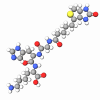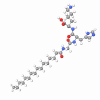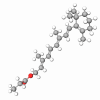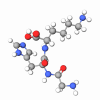
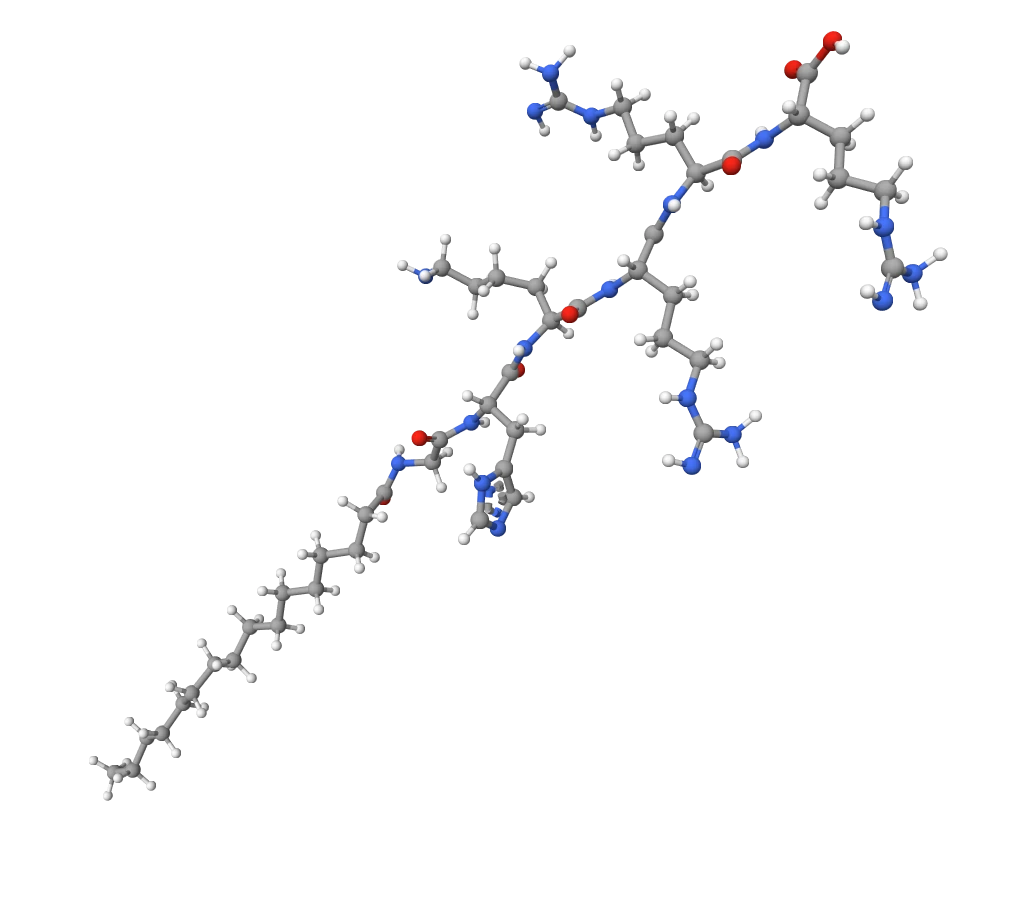
Palmitoyl Heptapeptide-48 is a synthetic lipopeptide, a palmitoylated version of Heptapeptide-48 (GHK-R4) that retains its anti-aging properties, with additional benefits including stability and penetration rates thanks to the lipophilic tail. It has the sequence Pal-Gly-His-Lys-Arg-Arg-Arg-Arg and is known in scientific literature as Pal-GHK-R4.
While the development of Heptapeptide-48 successfully addressed cellular uptake via the addition of a tetra-arginine cell-penetrating peptide, Palmitoyl Heptapeptide-48 introduces a secondary modification to penetration rates through the stratum corneum. By attaching a palmitoyl group to the N-terminus and an arginine oligomer to the C-terminus, researchers have created a dual-modified GHK peptide that overcomes both the skin barrier and the cell membrane.
Comparative studies indicate that the skin permeability of Palmitoyl Heptapeptide-48 is approximately 7-fold higher than that of standard, unmodified GHK. This allows a significantly greater proportion of the applied peptide to reach the deeper dermal layers.
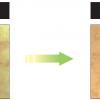
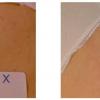
The biological potency of Palmitoyl Heptapeptide-48 is commensurately higher than that of its ancestor peptides GHK and GHKRRRR. In vitro evaluations of MMP-2 activity and collagen production demonstrate that this peptide achieves peak efficacy at concentrations roughly 100-fold lower than those of standard GHK. This huge increase in efficiency means the lipopeptide can effectively preserve the skin's integrity and stimulate the production of extracellular matrix (ECM) components at a fraction of the dosage typically required for signaling peptides, minimizing the potential cytotoxicity that can sometimes accompany high-concentration anti-aging formulations.A clinical trial involving 21 volunteers over 4 weeks confirmed a noticeable reduction in crow's feet depth after just 2 weeks of use, with continued improvement through the fourth week. Beyond its anti-wrinkle performance, Palmitoyl Heptapeptide-48 demonstrated a dual effect on the skin barrier: a significant increase in skin moisture content and a decrease in transepidermal water loss (TEWL). These results suggest enhancement in the skin's barrier function.
References
- Effect of oligoarginine conjugation on the antiwrinkle activity and transdermal delivery of GHK peptideDOI:10.1002/psc.3234
- Transdermal Delivery and Biological Activity of Arginine Oligomer Conjugation of Palmitoyl Tripeptide-1DOI:10.53894/ijirss.v5i3.652
- A Clinical Study on Anti-wrinkle Efficacy of Cosmetics Containing Oligoarginine Conjugation of Palmitoyl-GHK