The active skincare ingredient Argireline® (Acetyl Hexapeptide-8 former Acetyl Hexapeptide-3) is the result of 6 years of research that started in 1993 at the University of California in San Diego and ended in 1999 at Prof. Antonio Ferrer Montiel’s laboratory in Elche within the framework of collaboration between the Miguel Hernández University and Lipotec SA.
Argireline® was born thanks to the development of research projects that, on the one hand, defined the mechanisms of action of botulinum toxin, and on the other, laid out the molecular foundations for expression wrinkle formation. In parallel, the development of computer platforms for the design of active biopeptides was also a strong contributor.
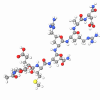
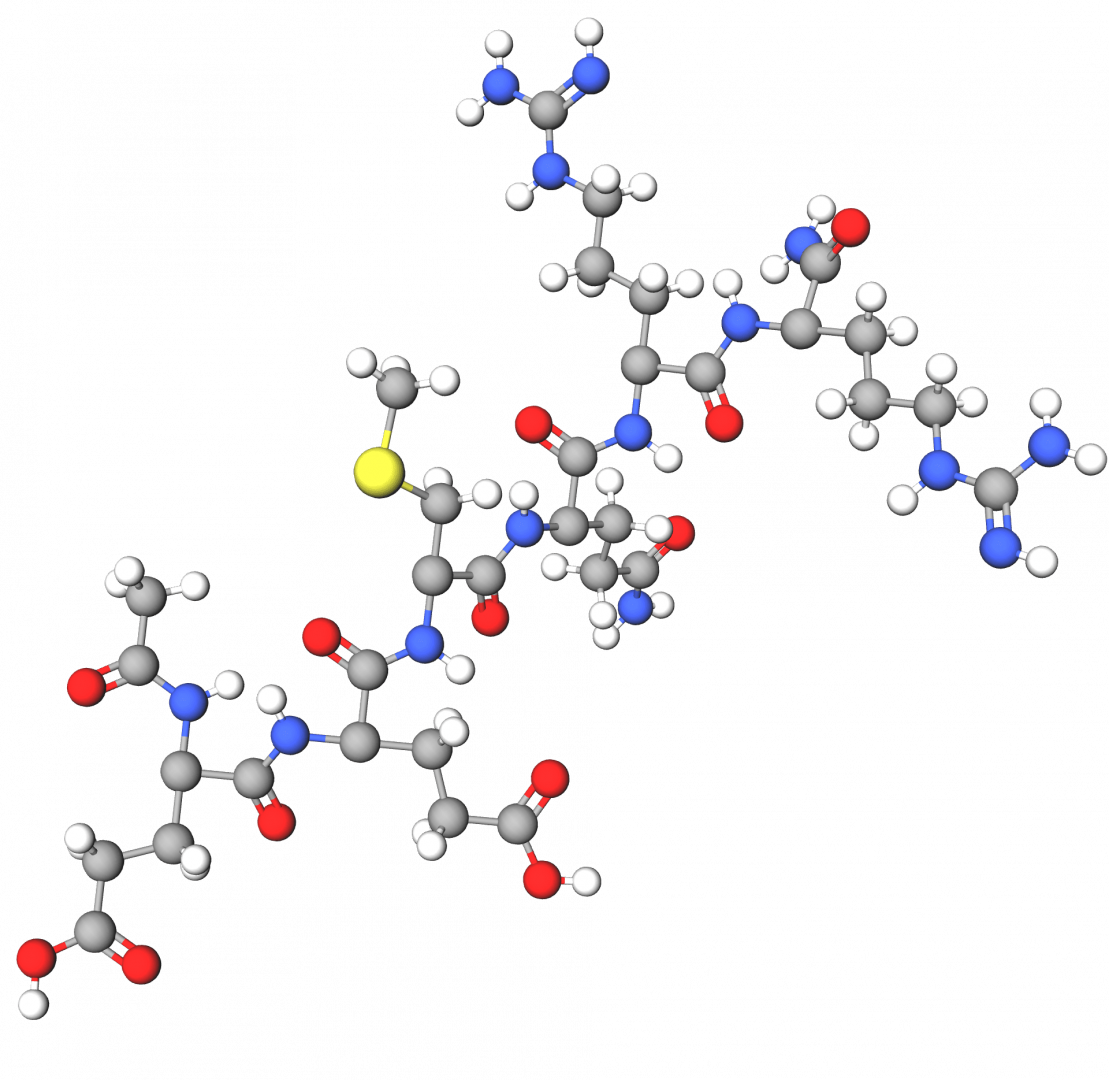
The Acetyl Hexapeptide-8 is, therefore, the result of successfully applying a rational molecular design to correct a cosmetic problem effectively. The sequence of the peptide is Ac-Glu-Glu-Met-Gln-Arg-Arg-NH2. The anti-wrinkle activity has led to this revolutionary Hexapeptide-3 which has taken the cosmetic world by storm.
F.A.Q.
How does Acetyl Hexapeptide-8 relax muscles?
Muscle contraction
Muscles are contracted when they receive neurotransmitters released from a nerve cell into synaptic space between neuron and muscle fiber in a process known as neuronal exocytosis.
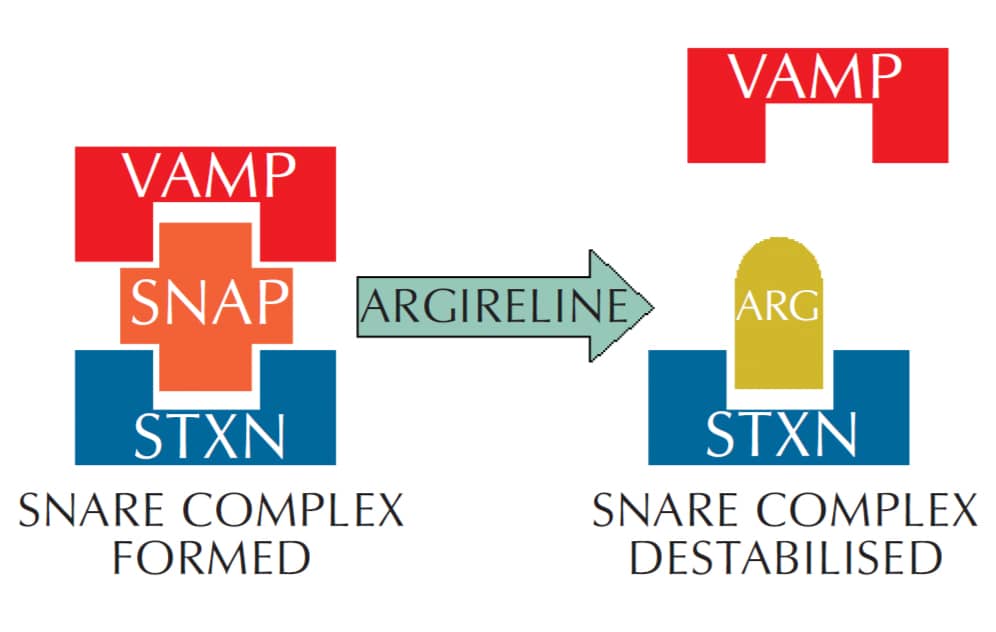
The neurotransmitter involved is acetylcholine and it is released from a vesicle into the synapse. The process involves several proteins, channels, and vesicles. The SNARE protein complex is essential for neurotransmitter release at the synapsis and mediates the final steps of exocytosis. It is a complex formed by three proteins: VAMP, Syntaxin, and SNAP-25. This complex is like a cellular hook that captures vesicles (this process called docking) and brings them close to the membrane to enable their fusion.
Botulinum toxin A
Botulinum Toxin A paralyzes the muscle by selectively blocking acetylcholine release at the neuromuscular junction. BoNT-A cleaves the protein SNAP-25 irreversibly, and therefore the SNARE complex cannot assemble.
The nerve signal cannot be relayed, the muscle cannot contract, and it is paralyzed.
Argireline®
Acetyl Hexapeptide-8 is a mimic of the N-terminal end of SNAP-25, and it competes with the natural protein for a position in the SNARE complex, so it destabilizes its formation without breaking any of its components.If the SNARE complex is slightly destabilized, the vesicle cannot release neurotransmitters. As a consequence, muscle contraction is attenuated, and the muscle is relaxed. Thus, it's a safer muscle relaxation method for anti-wrinkle effect.
References
- Topical peptides as cosmeceuticalsPMID:27451932DOI:10.4103/0378-6323.186500
- Argireline: Needle-Free Botox as Analytical ChallengePMID:33482052DOI:10.1002/cbdv.202000992
- The anti-wrinkle efficacy of ArgirelinePMID:23464592DOI:10.3109/14764172.2013.769273
- Chemical and biological properties of anti-wrinkle peptide ArgirelineDOI:10.52336/acm.2021.10.3.05
- Small peptides patterned after the N-terminus domain of SNAP25 inhibit SNARE complex assembly and regulated exocytosisPMID:14675156DOI:10.1046/j.1471-4159.2003.02133.x
- Investigating the effects of Argireline in a skin serum containing hyaluronic acids on skin surface wrinkles using the Visia® Complexion Analysis camera system for objective skin analysisPMID:38024099DOI:10.3205/iprs000179
- Safety Assessment of Acetyl Hexapeptide-8 Amide as Used in CosmeticsPMID:40673537DOI:10.1177/10915818251340391