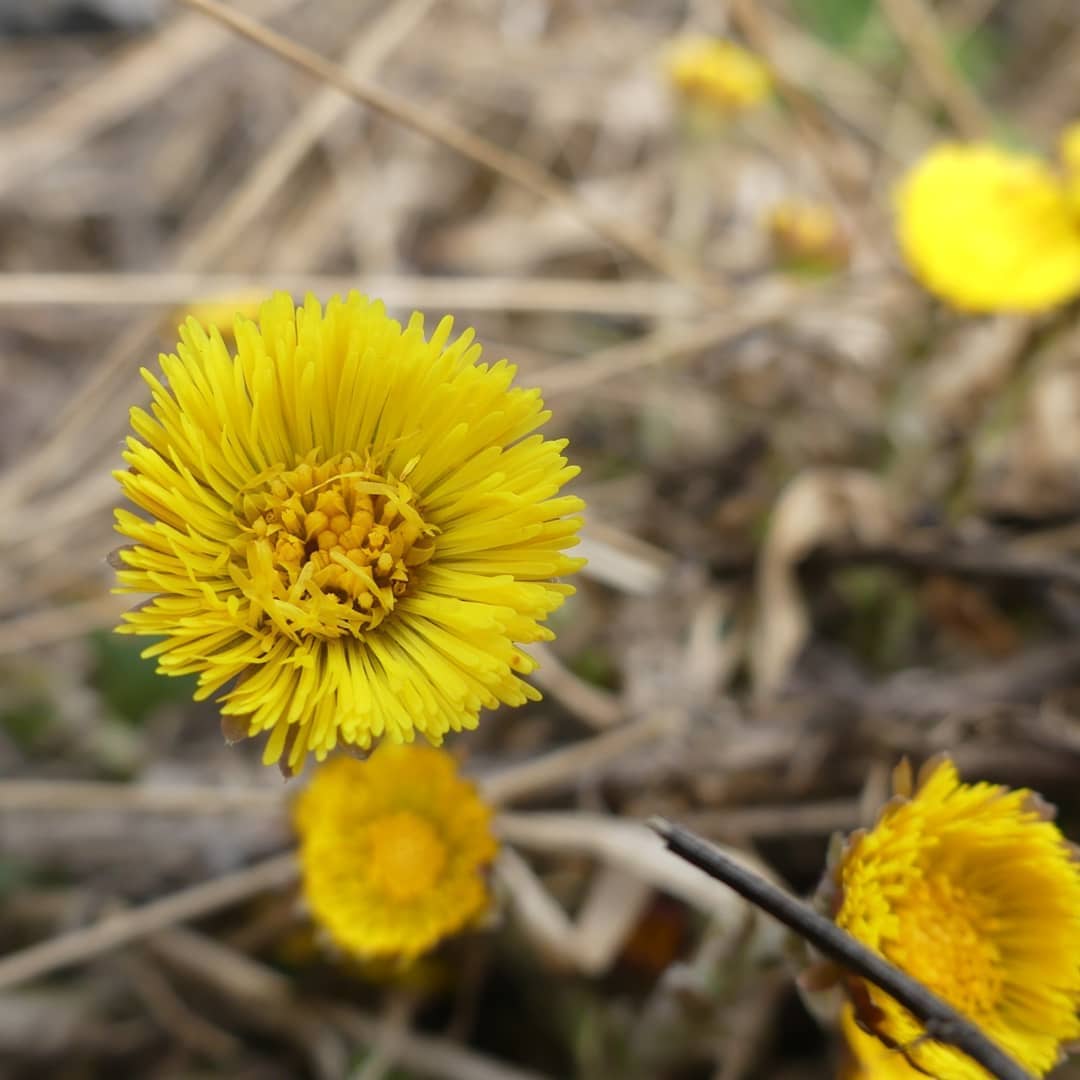
Tussilago Farfara Flower Extract is a light to medium amber liquid with a characteristic odor. Due to its soothing, antioxidant, and protective qualities, Coltsfoot Flower Extract is used in eye creams and other skin treatment products.
Naturalized in the United States, Coltsfoot (Tussilago Farfara) extract has been used as an antiseptic for open wounds, a poultice for scrofulous tumors, and a soothing agent for sore feet. It has also been used to treat bruises, fever, swelling, and skin irritations.
Coltsfoot can be used externally as a poultice for welts and swellings. Recent research has shown that polysaccharides are anti-inflammatory, immunostimulating, and demulcent, and flavonoids also exhibit these qualities.
Thanks to higher antioxidant content, Tussilago Farfara Flower Extract exhibits potent cytoprotective action, protecting dermal fibroblasts and keratinocytes from glucose oxidase-induced oxidative stress. Tussilagonone, a sesquiterpenoid isolated from Tussilago Farfara Flower Extract, showed promising results in the treatment of skin inflammatory conditions, including psoriasis.
Tussilago Farfara Flower Extract also inhibits UV-induced MMP-1 expression, preserving skin's structural proteins from UV-induced destruction and effectively protecting the skin from photoaging.
Identification of cytoprotective constituents of the flower buds of Tussilago farfara against glucose oxidase-induced oxidative stress in mouse fibroblast NIH3T3 cells and human keratinocyte HaCaT cells
Author(s):
Kang Unwoo, Park Jiyoung, Han Ah-Reum, Woo Mi Hee, Lee Je-Hyun, Lee Sang Kook, Chang Tong-Shin, Woo Hyun Ae, Seo Eun Kyoung
DOI:
10.1007/s12272-016-0730-z
A Comparative Analysis of the Anatomy, Phenolic Profile, and Antioxidant Capacity of Tussilago farfara L. Vegetative Organs
Author(s):
Bota V Beatrice, Neamtu A Adriana, Olah N Kinga, Chișe Elisabeta, Burtescu R Flavia, Pripon F F Roxana, Nicula A Sabin, Neamtu Carmen, Maghiar A Marius, Ivănescu L Carmen, Zamfirache M Magdalena, Mathe Endre, Turcuș Violet
DOI:
10.3390/plants11131663
Neuroprotective and anti-psoriatic activities of sesquiterpenoids from Tussilago farfara mediated through Nrf2 activation
Author(s):
Joohee Lee
Journal:
Seoul National University Institutional Repository
Development of effects of plant extracts on the activity and expression of UVA‐induced MMPs (matrix metalloproteases)
Author(s):
Lee D.‐H., Lee B.‐C., Yoon E.‐J., Lee K.‐E., Park S.‐M., Pyo H.‐B., Choe T.‐B.
Traditionally Horsetail (Equisetum arvense) extract has been used for the treatment of inflammatory conditions in Europe. Novel experimental findings showed that Equisetum arvense has a modulatory effect on T-leucocytes that producing mediators of inflammation. It provides an anti-inflammatory effect, soothing, smoothing edema, and eliminating irritation of the skin.
In Asia, Panax (means ‘treating all’ in Greek) is considered to be the most valuable plant among all, and its root called Ginseng became famous worldwide.
Tea processed by the method considered to be “Japanese Green Tea” yields the most useful extract since, in the process of manufacturing black tea, most of the polyphenols are oxidized to form dark-colored i
This critical herb has immune-enhancing, antibacterial, antibiotic, and anti-viral properties and contains antioxidants, which protect our cells against free radical damage.
Legend has it that if this plant is hung on doors or windows on St. John's birthday, it will keep away ghosts and devils for a year. In the Middle Ages, the Crusaders used the famous red oil of St.
Marshmallow root extract is rich in asparagine, pectin, starch, sugars, tannins, and volatile oil, with excellent antioxidant, moisturizing and soothing properties.
Vaccinium Myrtillus (Bilberry) Fruit/Leaf Extract is a light to medium amber liquid with a characteristic odor. It is soluble in water in any proportion.
To the ancient Arabians, Sage (Salvia Officinalis) was associated with immortality and longevity. They also credited Salvia Officinalis with increasing mental capacity.