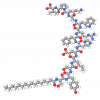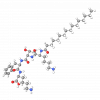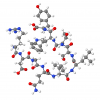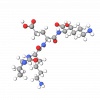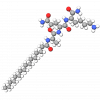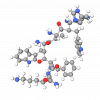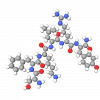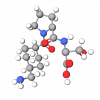

Palmitoyl Dipeptide-61 D-Leucine Dipeptide-62 D-Alanine Dipeptide-63 is a synthetic lipopeptide that inhibits tyrosinase activity. It has the sequence Pal-lle-Ser-D-Leu-Leu-Asp-D-Ala-Gln-Ser-NH2 and is used in the advanced peptide-based complex X50® Pure White as an intracellular-acting core peptide.
The original sequence lle-Ser-Leu-Leu-Asp-Ala-Gln-Ser corresponds to bovine β-Lactoglobulin (45;52). Many studies show that β-lactoglobulin and its derivative peptides or hydrolysate fragments have a skin-whitening effect and can be used to treat skin hyperpigmentation, dark spots, and other discolorations.
According to the manufacturer, replacement of Leucine3 and Alanine6 amino acid residues in the original sequence with their D froms, improves peptide efficiency, making the peptide a more potent tyrosinase inhibitor. The manufacturer also tested Acetyl and Palmitoyl derivatives of the base peptide and found that Palmitoyl Dipeptide-61 D-Leucine Dipeptide-62 D-Alanine Dipeptide-63 is the most powerful.
Tyrosinase is an enzyme required for melanin production. Palmitoyl Dipeptide-61 D-Leucine Dipeptide-62 D-Alanine Dipeptide-63 breaks the chain of biochemical reactions involved in melanin production by melanocytes. In X50® Pure White, it is encapsulated in PLGA, serving as the primary active ingredient delivered into melanocytes.